

Metal Turnover Box
Product Overview
A Metal Turnover Box is a heavy-duty industrial container engineered to collect, store, transport, and transfer raw materials, components, and work-in-process items between workstations, production areas, and storage locations.
Depending on its construction, a turnover box may also support material discharge through a tipping, pivoting, or bottom-opening mechanism. The actual operating method depends on the selected configuration.
When selecting a Metal Turnover Box, buyers should evaluate more than external dimensions. Payload capacity, usable internal space, material characteristics, handling interfaces, discharge requirements, and compatibility with existing plant equipment all dictate product suitability.
-
 Galvanised Steel ContainerThis box is made of galvanised steel. The zinc coating prevents rust. The galvanised steel container is very strong and can be used for many years. It performs well in warehouses, workshops, and...Add to Inquiry
-
 Steel Metal ContainersThis steel metal containers is a general-purpose logistics container. It is made from high-quality steel. The steel containers are very strong and durable. They can be stacked on top of each...Add to Inquiry
-
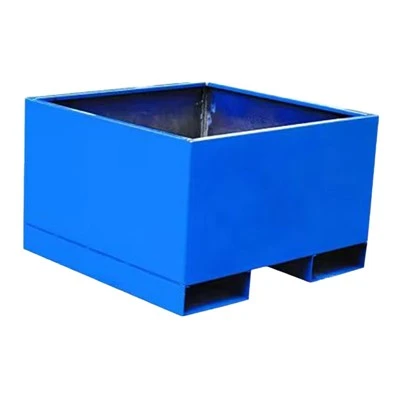 Industrial Stainless Steel ContainersThis box is a industrial stainless steel containers. It is made from stainless steel and high-quality cold-rolled steel. The stainless steel containers are rust-proof and resistant to acids and...Add to Inquiry
-
 Industrial Steel ContainersThis box is a heavy-duty logistics container. It is made of steel. The steel containers are very strong and durable. They can be stacked in multiple layers. The bottom feet feature an anti-fall...Add to Inquiry
-
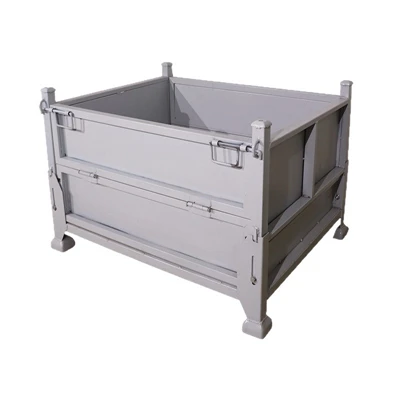 Collapsible Steel ContainersThis box is designed to save space. It is made from steel. The collapsible steel containers can be folded down on all four sides. When not in use, they can be folded flat. The folded height is...Add to Inquiry


Main Structural Components
Container Body: Forms the material-holding compartment. Internal dimensions, wall thickness, opening arrangement, and internal geometry are matched to the specific handling characteristics of the material.
Base and Reinforcement Structure: Supports contents and transfers loads to the floor or handling equipment. Plate thickness and reinforcement layouts are engineered according to the specified payload and operating conditions.
Handling Interfaces: Forklift pockets, lifting points, or AGV locators are incorporated per design requirements. Dimensions, spacing, and positioning must align with plant handling machinery.
Turnover & Discharge Mechanisms: Tipping arrangements, pivoting structures, or bottom-opening mechanisms must be selected based on the unloading method. These configurations are not interchangeable and require distinct operational verification.
Stacking Features: Interlocking locators or corner posts ensure stable multi-tier vertical storage. Permitted stacking height and loaded capacity must be confirmed for the specific design.
Working Principle
During standard operation, materials are loaded into the container and transferred between designated areas. For turnover-enabled models, the box is positioned at a discharge point and operated via an approved tipping cycle or forklift rotator to release contents smoothly into receiving hoppers or assembly lines.
Key Features and Benefits
Robust Metal Construction: Specified for rigorous industrial collection, storage, and transfer, utilizing carbon steel grades and plate thicknesses matched to expected impact and abrasion levels.
Application-Matched Dimensions: Usable internal dimensions are optimized for specific workpieces or bulk materials, preventing bridging or jamming during unloading.
Equipment Compatibility: Handling interfaces (forklift pockets, crane lugs) are custom-engineered to match existing site machinery, eliminating slip hazards during transit.
Controlled Discharge Performance: Tipping, pivoting, or bottom-opening arrangements are tailored to material flow characteristics, reducing operator fatigue and safety risks.
Applications & 7-Step Selection Guide
Typical Application Areas
Manufacturing & Assembly: Transferring precision components and sub-assemblies between production cells.
Work-in-Process (WIP) Buffer Storage: Storing parts securely between machining, assembly, and inspection.
Metal Scrap Collection: Handling metal chips, offcuts, and stamping waste with high resistance to sharp edges and heavy impact.
Automated Line Discharge: Releasing components directly into automated feeders via dedicated tipping turnover boxes.
Step-by-Step Selection Guide
Step 1: Identify the Material
Specify individual parts, irregular workpieces, scrap, or bulk materials (include bulk density).
Step 2: Establish the Payload
Determine the maximum material weight per box and load distribution independently of volume.
Step 3: Confirm Dimensions & Capacity
Define internal vs. external dimensions to ensure fit with racks, conveyors, and workstations.
Step 4: Specify Handling Equipment
Identify forklifts, cranes, or AGVs, and confirm entry directions and interface dimensions.
Step 5: Define Discharge Method
Clarify manual unloading, tipping, or bottom-opening, along with receiving heights and clearances.
Step 6: Evaluate Operating Environment
Factor in indoor/outdoor exposure, moisture, chemicals, and cleaning requirements.
Step 7: Confirm Stacking Limits
Specify empty vs. loaded stacking requirements and maximum tier limits.
Technical Specifications for RFQ
|
Technical Parameter |
Engineering Specification & Options to Confirm |
|
Product Classification |
Heavy-Duty Industrial Metal Turnover Box (Custom Configured) |
|
Overall & Internal Dimensions |
External footprint x Usable internal length, width, and height |
|
Usable Capacity & Payload |
Target volume (L/m3) & Maximum Safe Working Load (SWL in kg) |
|
Primary Material & Thickness |
Certified structural steel grade (e.g., Q235B/Q355B/ASTM A36); Body/Base plate thickness |
|
Handling Interfaces |
Forklift pocket dimensions/spacing, crane lugs, or AGV locators |
|
Discharge Mechanism |
Fixed, Tipping, Pivoting, or Bottom-Opening configuration |
|
Surface Finish |
Shot-blasted + Industrial Epoxy Powder Coat or Hot-Dip Galvanized (HDG) |
|
Quality Documentation |
Material Test Certificates (MTC), Dimensional Inspection Reports |
Manufacturing and Quality Control
Our production workflow ensures absolute structural reliability:
Material Verification
Steel plates and structural members are verified against Mill Test Certificates (MTC) prior to fabrication.
Precision Fabrication
CNC cutting and hydraulic forming maintain strict dimensional tolerances (+/- 1.0 mm).
Certified Welding
Professional weld assembly ensures deep penetration and robust structural integrity.
Inspection & Testing
Dimensional checks, interface verifications, and optional functional tests (for turnover mechanisms) are executed prior to global shipping.

Customization and Technical Support
When standard configurations do not match your facility layout, our engineering team provides tailored design solutions.
Information to Include in Your RFQ Inquiry:
Product Drawings: Product drawings, concept sketches, or existing container photographs.
Dimensions and Capacity: Required internal/external dimensions and target capacity.
Maximum Payload: Maximum payload weight (Safe Working Load).
Handling Equipment: Handling equipment specifications and interface measurements.
Turnover and Discharge Requirements: Turnover/discharge method and operational environment.
Order and Delivery Requirements: Target order quantity, delivery destination (FOB/CIF), and documentation needs.
As one of the most professional metal turnover box manufacturers and suppliers in China, we warmly welcome you to wholesale customized metal turnover box at competitive price from our factory. If you have any enquiry about quotation, please feel free to email us.
Heavy duty steel container, metal turnover box, Steel metal industrial storage bin